Position Paper of the EU BIM Task Group on Digital Building Permits


The EU BIM Task Group publishes its new position paper on Digital Building Permitting.

Digital Building Permitting is no longer just a technical experiment. The next challenge is to make it scalable, interoperable and practical for public authorities across Europe.

Building on the recent study commissioned by the European Commission’s DG GROW, the EU BIM Task Group’s new position paper calls for a coordinated European approach that respects national and local regulatory responsibilities while reducing duplicated development efforts.

The paper sets out how the EU BIM Task Group can contribute as a practical public-sector expert platform, connecting policy, standardisation, research and real-world implementation.

Its key priorities include:

  • Common implementation guidance, open standards and reusable technical components.
  • Stronger collaboration with CEN, buildingSMART International, EUnet4DBP and the research community.
  • Practical capacity-building and shared solutions for municipalities.
  • Better integration between Digital Building Permitting, urban planning information models and future building lifecycle data infrastructures.

The objective is not to create one uniform European permitting system, but to establish common foundations that Member States and municipalities can adapt to their own needs.

Read the position paper to explore the EU BIM Task Group’s proposed role and seven recommended next steps towards a more coherent European Digital Building Permitting ecosystem.

–> Download Here

European Study on Digital Building Permits: Best Practices and Recommendations

A new study commissioned by the European Commission’s DG GROW examines how digital building permitting can help Europe deliver housing, reduce administrative burdens and accelerate the digital transformation of construction.

Building permits are where Europe’s housing, climate and digital ambitions meet reality. Across Europe, permitting processes remain a significant bottleneck in construction and renovation. Fragmented procedures, document-based workflows and repeated manual checks can delay projects, increase costs and limit the reuse of valuable building information.

To address these challenges, the European Commission’s Directorate-General for Internal Market, Industry, Entrepreneurship and SMEs (DG GROW) commissioned the EU BIM Task Group to assess the concept and potential impact of implementing Digital Building Permits (DBP) across the EU construction sector.

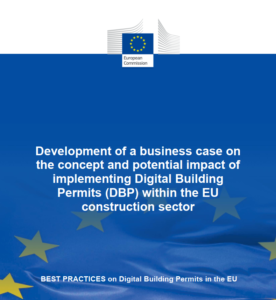
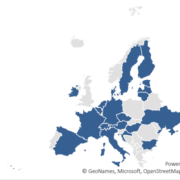
The resulting study, Development of a business case on the concept and potential impact of implementing Digital Building Permits (DBP) within the EU construction sector – Best Practices on Digital Building Permits in the EU, examines current practices in Austria, Estonia, Finland, Germany, the Netherlands and Spain. It brings together practical experience, regulatory analysis and stakeholder perspectives to identify the benefits, barriers and opportunities for wider European adoption.

From digital documents to data-driven permitting

The study’s central finding is that Digital Building Permits are no longer merely an experimental concept. Model-based approaches are already demonstrating their potential to improve efficiency, transparency and regulatory consistency. However, the real transformation is not simply replacing paper with electronic documents. It is about creating interoperable processes in which structured information can be checked, exchanged and reused.

The study identifies several important benefits:

  • Faster and more predictable processes: Automated pre-checking and structured submissions can reduce repetitive manual work and avoidable correction cycles.
  • Greater transparency and consistency: Traceable rule checks and model-linked feedback help applicants and authorities understand requirements and resolve issues more effectively.
  • Better use of public resources: Shared digital infrastructure and reusable solutions can reduce duplication and support municipalities with limited technical capacity.
  • Information that remains valuable: Structured building data can support urban planning, digital twins, renovation and asset management beyond the permitting stage.
  • Support for wider European priorities: More efficient permitting can contribute to affordable housing delivery, industrialised construction and the transition towards a sustainable built environment.

Technology alone is not enough

The experience gathered across the six countries shows that successful implementation depends on aligning technology with legal frameworks, administrative processes and institutional capacity. Open standards such as IFC, clear information requirements and machine-readable rules are essential, but they must be supported by public-sector leadership, training, stable governance and long-term investment.

The study also highlights the importance of a gradual approach. Starting with clearly defined, measurable and high-impact requirements allows authorities to deliver practical benefits while building confidence and preparing for wider adoption. Automated checks should support professional judgement and legal accountability, not replace them.

A European opportunity for shared solutions

Although permitting remains a national, regional or municipal responsibility, the study identifies substantial common ground in the information and processes required across Europe. This creates an opportunity to develop shared foundations while respecting differences in legislation and administrative structures.

The recommendations call for coordinated EU action to promote common data requirements, interoperable standards and reusable rule libraries; strengthen municipal capacity through training and shared infrastructure; and support implementation through targeted funding. The study also recommends extending digital permitting to renovation and exploring approaches such as type approvals for standardised housing solutions.

These measures could help reduce duplicated development efforts, improve access to digital solutions for smaller municipalities and create a more predictable environment for the European construction sector.

Beyond permitting: enabling Europe’s built-environment ambitions

Digital Building Permits should be understood as more than an administrative reform. They are a strategic enabler connecting the digital transformation of construction with Europe’s objectives for affordable housing, climate neutrality, renovation and competitiveness.

By bringing together public authorities, policymakers, researchers and industry expertise, the EU BIM Task Group provides a platform for turning national and local experience into shared European knowledge. This study offers a practical foundation for the next stage of that collaboration: moving from individual initiatives towards interoperable, scalable and sustainable digital permitting across Europe.

Read the full study to explore the six country analyses, practical lessons and recommendations for EU-wide adoption.

–> Download Here

Read the Second Handbook of the EU BIM Task Group on Twin Transition


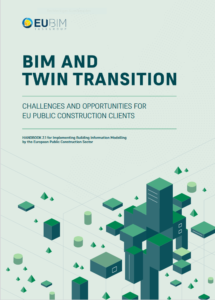
The second handbook of the EU BIM Task Group aims to support EU public clients and policy makers by the implementation of the EU “Twin Transition” and thus to ensure a more resilient, green and digital construction ecosystem.

Starting with an analysis of the current complex policy framework, it elaborates on the opportunities and challenges of existing data methods, like LCA and BIM. Then it explores digital tools such as EPD, DPP and DBL and their joint role for a successful implementation of the Twin Transition. In conclusion, it offers implementation strategies and an outlook till 2030 for the EU Twin Transition. It blends together experiences from academic research and practice, the status quo of a work in progress, as we expect to gain more valuable insights from further use cases in the future – the findings will be presented in the following version.

–> Download Here

EUBTG_GA_2025_Vienna

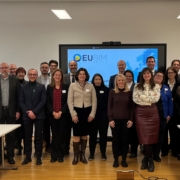
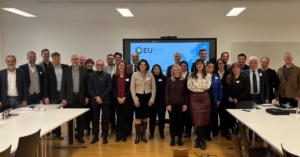
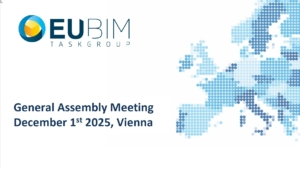
General Assembly of the EU BIM Task Group 2025 in Vienna

On December 1st 2025 we held or  annual General Assembly meeting in Vienna hosted by the Technical University Vienna) and the support form BIG Austria.

Moderated by Milena Feustel, Chair of the Group, the General Assembly was another excellent opportunity to boost the exchange between our members and strengthen the collaboration within the Group and with important stakeholders such as DG GROW, buildingSmart International and CEN.

EUBTG_GA_2025_Vienna


A strong program brought together policy direction, standardisation alignment and concrete actions:
Pablo Gutierrez Velayos from European Commission shared EC priorities and the wider policy direction for digitalisation in construction.
Leoš Svoboda presented European openBIM Forums openBIM Harmony and how it can support greater consistency across guidance, requirements, and implementation.

  • Cornelius Preidel showed the advantages of BIMcert, the internationally recognised buildingSMART Professional Certification Program
  • Christoph Eichler delivered an important call to action on IFC4, focusing on accelerating adoption to make digital building documentation truly future-proof.
    Peter Kompolschek provided an update on CEN/TC 442 activities and how standardisation work is progressing in support of interoperable digital delivery.
    • Each country gave an update on the latest developments on the digitisation of the construction sector.
  • Milena Feustel outlined current initiatives and collaboration lines, including ongoing coordination with key European and international partners.

Full Agenda:

10:00 – 10:30 Coffee and arrival

10:30 – 10:45 Opening words by Chair and DG GROW

10:45 – 11:05 Current Activities and Collaboration with the European Commission

  • Update DG GROW (Pablo Guitierrez Velayos)
  • Update EU BIM Task Group (Milena Feustel)

11:05-12:00 Collaboration with buildingSmart International:

  • BIM Harmony (Leos Svoboda/Cornelius Preidel tbc )
  • IFC 4: Making digital building documentation future-proof – a call for action to asset owners (Christoph Eichler)

12:00 – 13:00 Lunch

13:00 – 13:30 Collaboration with CEN TC442 (Peter Kompoltschek)

13:00 – 13:45 Update Working Groups, Workshops since last General Assembly

13:45 – 15:00 Members updates: how can we support each other?

15:00 – 15:15 Networking Coffee break

15:15 – 15:45 – Members updates continued

15:45 – 16:45 EU BTG planning 2026

  • Workshops, Working Groups, focus activities, organizational issues, internet, etc
  •  Steering Committee and Chairs

16:45 – 17:00 – Wrap-up and closing

The General Assembly also underscored the strength and continuity of the Task Group’s leadership under  Milena Feustel as a Chair and Dmitrijs Kots as a Co-Chair. In the same spirit of reinforcing our capacity to deliver, we welcomed Christopher Raitviir as a new Co-Chair to help the organisation grow even stronger.


All the presentation slides can be downloaded as a single PDF file (10MB)

GA Meeting Presentations12/01/25 Vienna Main Page

If you have any questions or comments about the General Assembly meeting then please write to admin@eubim.eu.

Just Published: Position Paper of the EU BIM Task Group on BIM for Public Procurement

Working Group finalises the Position Paper in November 2025.

Our Position Paper highlights that BIM, according to ISO 19650, is not simply a technology but a structured approach to managing information throughout the lifecycle of a public asset. The document stresses that “BIM refers not only to tools and technologies, but to a methodological approach aimed at achieving defined objectives” such as risk reduction and improved planning.

Public procurement is one of Europe’s strongest levers to accelerate modernisation in the built environment. Our paper sets out why BIM should be embedded more consistently in public procurement to improve outcomes for citizens.

While BIM adoption is progressing, requirements still vary widely across Member States. This fragmentation creates friction for cross-border delivery, weakens interoperability, and risks widening the digital divide. We therefore call for a coordinated EU-level framework that defines minimum, harmonised BIM requirements (with a strong focus on vendor-neutral openBIM) while leaving room for Member States to specify detailed technical and regulatory measures within a common structure.

A more aligned approach would help public clients and industry to:
👉 increase value for money and reduce delivery risk
👉strengthen transparency and comparability in tendering
👉support sustainability and circularity objectives (including lifecycle perspectives)
👉enable interoperable, data-driven project delivery and asset management

To support implementation, the paper also highlights the importance of shared guidance and templates, capacity-building through knowledge exchange, and stronger integration of BIM into public procurement and permitting processes.

Download here: Position Paper of the EUBIM Taskgroup on BIM for Public Procurement

Cyprus Joins EU-BIM Task Group

We are happy to welcome Cyprus as our 28th Member State and looking forward to collaborating on a successful EU BIM-Journey.

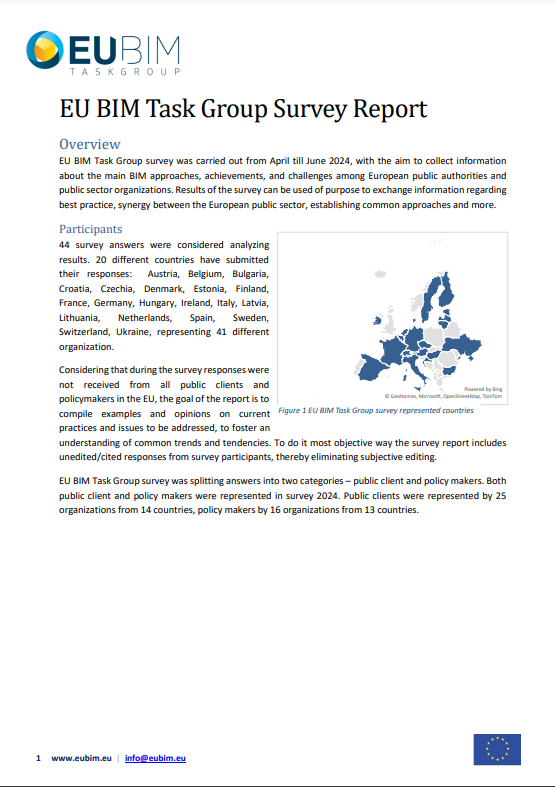
2024 BIM Survey Report for Public Clients and Policy Makers

2024 BIM survey report about BIM implementation status among European public clients and policy makers by the EU BIM Task Group is available now.”


If you have any questions or comments regarding the survey then please send them to admin@eubim.eu.

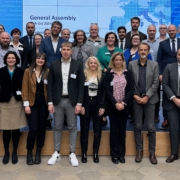
EUBTG General Assembly Group Photo

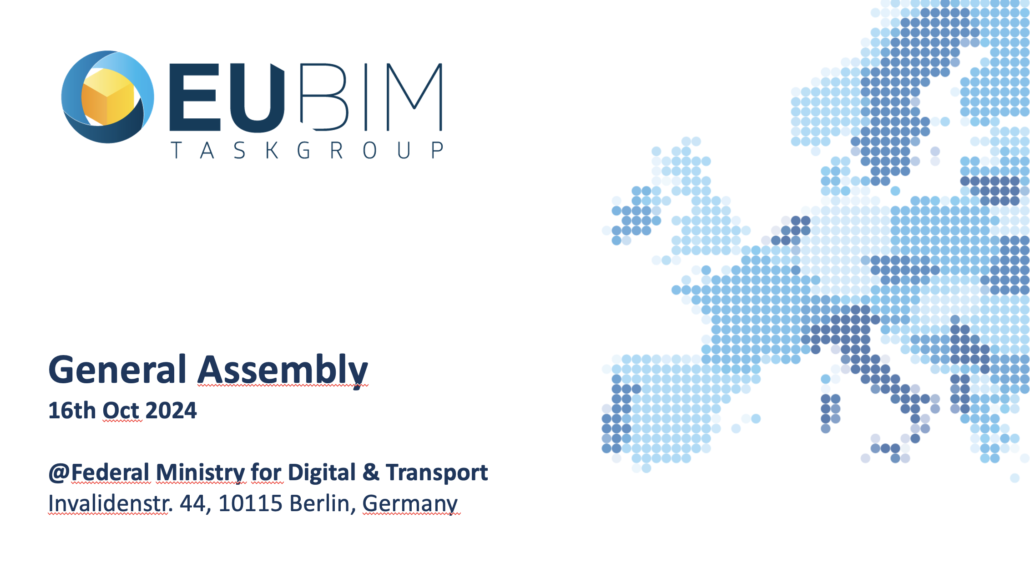
EU BIM Task Group General Assembly 2024

On October 16th 2024 the EU BIM Task Group (EUBTG) held it’s annual General Assembly meeting in Berlin hosted by the Federal Ministry for Digital and Transport. Milena Feustel was appointed as Chair of EUBTG and Dmitrijs Kots as Co-chair until the next General Assembly. 

The meeting was moderated by chair Jaan Saar and Milena Feustel.  The meeting included 2 keynotes from Thomas Liebich about ISO/CEN/bSi standards and Christophe Sykes about CPR and construction products.

Additional speakers included Aidan Mercer from buildingSMART International, Pablo Gutierrez from DG GROW, Georgios Kontopoulos from PwC presenting the results of the EC study on “Support of the digitalisation of the built environment, public procurement and SMEs in construction”, Anna Moreno about the establishment of the EU openBIM Forum and Anette Persson about EPBD implications.

And we had country updates by members from Austria, Croatia, Czech Republic, Estonia, Finland, France, Germany, Greece, Hungary, Ireland, Italy, Lithuania, Slovakia, Slovenia, Sweden, Ukraine and also the European Parliament.

The full agenda:

09:00 – 09:30   Coffee and arrival
09:30 – 09:45   Opening words by chairs and DG GROW
09:45 – 10:40   Keynote presentations:

  • Christophe Sykes, Director General of Construction Products Europe
    “Implications of a revised EU legal framework for construction products (CPR)”
  • Thomas Liebich from buildingSMART Germany
    “Update on IFC and IDS developments”

10:40 – 10:50   Our contribution to EC activities and collaboration with DG GROW, planned activities 2025/2026 (Pablo Gutierrez, DG GROW)
10:50 – 11:00   “Digitalisation of the built environment” study results (Georgios Kontopoulos, PwC)
11:00 – 11:20   EPBD implications for the future (Anette Persson, DG ENER)
11:20 – 11:40   Establishment of the European openBIM Forum (Anna Moreno, buildingSMART Italy) and update on buildingSMART International main activities (Aidan Mercer, bSi)
11:40 – 12:00   EUBTG Workshops overview (Jaroslav Nechyba
12:00 – 13:00   Lunch
13:00 – 13:15   EUBTG Survey results overview (Dmitrijs Kots)
13:15 – 14:15   EUBTG planning 2025:

  • Changes in EUBTG chair/co-chair positions
  • Establishment of a possible advisory Board for EUBTG?
  • 2025 focus activities (survey comments, on-site discussion)
  • Collaboration with EUBIM Public Officials Group

14:15 – 15:15   Members updates, updates from last GA, how can the EUBTG support you?
15:15 – 15:45   Networking Coffee break
15:45 – 16:45 – Members updates continued…
16:45 – 17:00 – Wrap-up and closing

All the presentation slides can be downloaded as a single PDF file (27MB)

Along with updates and presentations the General Assembly also approved changes in the leadership of the EU BIM Task Group. Current Chair Jaan Saar and Co-Chair Jaroslav Nechyba relinquished their positions due to moving into the private sector. Current Co-chair Milena Feustel was appointed as the new Chair and Steering Committee member Dmitrijs Kots was appointed as new Co-chair. Congratulations to Milena and Dmitrijs 👏

Below are also some photos of the event in the wonderful venue graciously provided by the German Federal Ministry for Digital and Transport. If you have any questions or comments about the General Assembly meeting then please write to admin@eubim.eu.

BIM Survey for Public Clients and Policy Makers

As part of our 2024 activities plan, the EU BIM Task Group is publishing the public sector survey to obtain valid information about BIM implementation status in EU member states.

The EU BIM Task Group kindly invites all European public clients and policy makers you to fill out the on-line BIM survey on the EU Surbey platform here:
https://ec.europa.eu/eusurvey/runner/EUBTG_BIM_survey_2024

The survey consists of two parts of questions depending on the type of respondent (public client or policy maker). With this survey we will collect valuable information about the main BIM approaches, achievements, and challenges among European public authorities and public sector organisations. This will contribute to the exchange of best practices, establishing a common approach, and synergy between the European public sector. Moreover, the results of the survey will help to make decisions based on data, as defined in the vision of the EU BIM Task Group.

That’s why getting as wide a range of responses from the public sector is crucial. Feel free to send the survey to other policymakers and public clients in your network.

We kindly ask you to complete the survey by the end of May.

After completing the survey, the EUBTG Steering Committee will analyse and evaluate the responses. The collected information will be available to all EU BIM Task Group members and the conclusions will be presented at the General Assembly. Afterwards the summart report from this survey will also be published on the EU BIM Task Group website.

If you have any questions or comments regarding the survey then please send them to admin@eubim.eu.

Knowledge Sharing Workshops

One of the main activities of the EU BIM Task Group for 2023 is the organization of knowledge transfer workshops. The goal of the workshops is to have active round table discussions with on-site participants using the following format:

  • Discussion moderated workshop without long boring presentations.
  • 20-30 participants maximum to be able to keep discussions interesting and let any participant take an active part in the debate.
  • Topics and agenda of the workshop can be in advance shape by registered participants.
  • Outcome: Knowledge and suggestion document that will be published on the EUBTG website after the workshop

The first 3 workshops were already agreed in early 2023 with the following topics:

The workshops have been a very big success with the first 2 workshops attended by over 50 people from 15 different countries.

Results of the workshops:

Workshop I: Open BIM – Information Requirements (PDF)

Workshop II: Common Data Environment (CDE) in the Public Sector (PDF)