
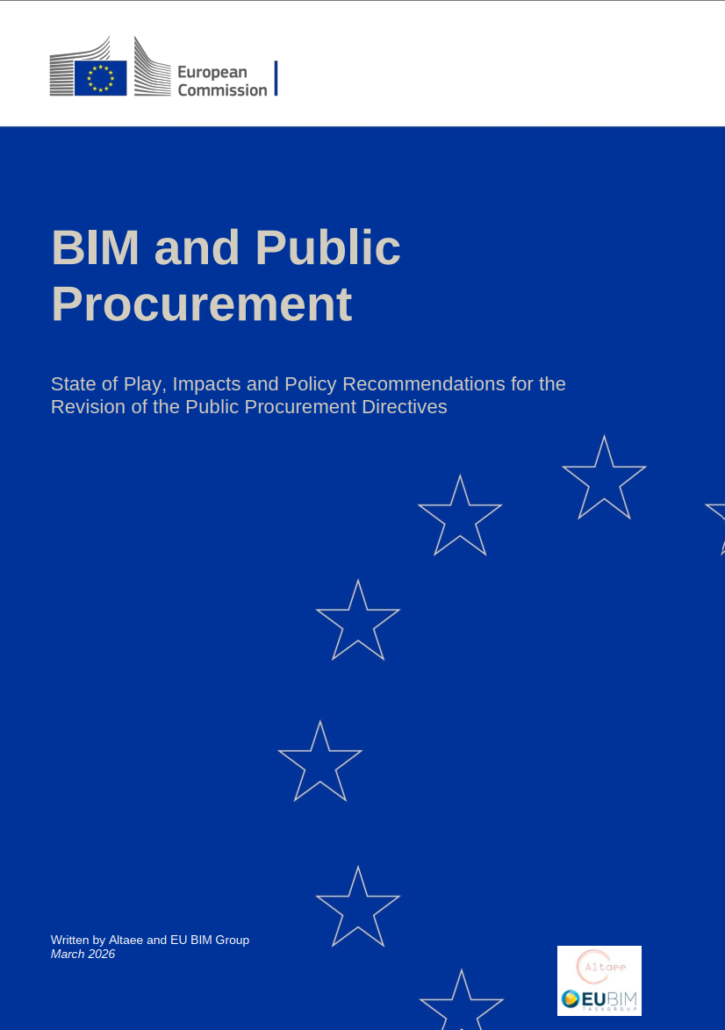
European Study on BIM and Public Procurement: State of Play, Impacts and Policy Recommendations
A new study prepared for the European Commission’s DG GROW examines BIM adoption across Europe and explores how the revision of the EU Public Procurement Directives could accelerate digital transformation in construction.
Public procurement is one of Europe’s most powerful instruments for driving innovation, sustainability and productivity in the construction sector. Yet, despite growing recognition of Building Information Modelling (BIM), its adoption remains fragmented across Member States, public authorities and the construction industry.
The ongoing revision of the EU Public Procurement Directives presents an important opportunity to establish a clearer and more coordinated European approach.
The study, BIM and Public Procurement – State of Play, Impacts and Policy Recommendations for the Revision of the Public Procurement Directives, was prepared by Altaee and the EU BIM Task Group for the European Commission’s Directorate-General for Internal Market, Industry, Entrepreneurship and SMEs (DG GROW).
Drawing on evidence from six Member States — Austria, Czech Republic, France, Germany, Greece and Portugal — the study examines BIM maturity, economic and organisational impacts, implementation barriers and potential approaches for strengthening BIM within the European public procurement framework.
BIM adoption is progressing, but not equally
The study confirms that BIM has moved beyond experimentation and is already delivering benefits in public construction projects. Improved coordination, reduced errors and rework, better cost predictability and more effective lifecycle information management demonstrate its potential to improve the value of public investments.
However, a significant gap remains between large, digitally mature organisations and smaller companies or public contracting authorities.
One of the central findings is that the main barriers to wider BIM adoption are increasingly institutional and organisational rather than technological. Skills shortages, inconsistent information requirements, fragmented guidance, legal uncertainty and limited public-sector capacity continue to prevent the wider adoption of BIM.
The study also emphasises that BIM creates value through structured information management across the asset lifecycle — not simply through producing digital models.
Should BIM become mandatory in European public procurement?
A central contribution of the study is its assessment of three possible policy approaches:
- Maintaining the current framework, where BIM can be required but without common EU-level definitions or requirements.
- Introducing a structured voluntary approach, supported by harmonised guidance, open standards and common information requirements.
- Establishing proportionate mandatory BIM requirements, introduced gradually according to project value, complexity and market readiness.
The analysis identifies a phased, threshold-based approach as a credible pathway towards wider BIM adoption, provided that requirements are supported by clear standards, training, appropriate transition periods and measures protecting SMEs from disproportionate burdens.
The key policy question is therefore not simply whether BIM should be mandatory, but how Europe can introduce consistent and proportionate requirements that deliver real value without creating unnecessary costs or barriers to competition.
Towards a more coordinated European approach
The study highlights several priorities for future EU action:
- Common, open and interoperable information standards and procurement requirements.
- Stronger BIM capabilities among public contracting authorities.
- Proportionate requirements linked to project needs, value and complexity.
- Practical support for SMEs, including training and shared digital infrastructure.
- A phased implementation roadmap that enables long-term information reuse and lifecycle value.
These recommendations offer valuable input for the revision of the Public Procurement Directives and the wider European agenda for a competitive, innovative and sustainable construction sector.
The EU BIM Task Group remains committed to supporting European policymakers and public-sector organisations in translating digital construction ambitions into practical, scalable implementation.
Read the full study to explore the six country analyses, stakeholder perspectives and policy scenarios for the future of BIM in European public procurement.

Leave a Reply
Want to join the discussion?Feel free to contribute!